By Kay M. Phiel, Gwinnett County Master Gardener
In early May, 2011, a friend and I took a Road Scholar/Elderhostle program to the Black Hills, Bad Lands, and Mount Rushmore in South Dakota. We were surprised to see a Prairie Homestead out in the very desolate-looking Bad Lands area of western South Dakota. It was raining fairly heavily that day so we didn’t explore as much as we might have. I picked up a brochure just before we reboarded the bus and was surprised to read a portion on Iris Gardens. We did not actually see the iris’ when we were there, as they were in another area, but I thought you might find the brochure interesting.
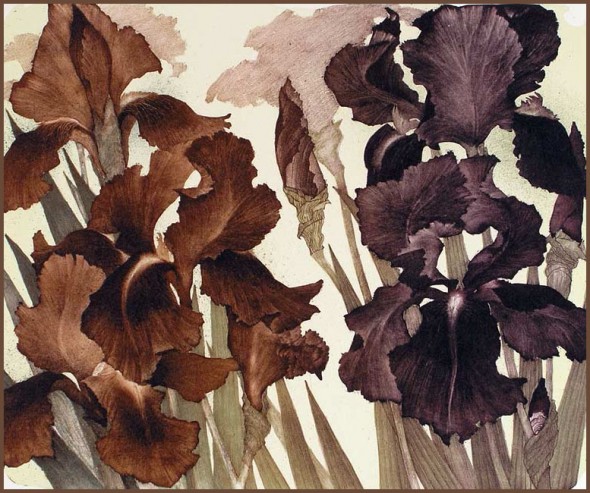
Iris Gardens
(Retyped from a brochure about a Prairie Homestead in the Bad Lands, Philip, South Dakota)
“When the first Homesteaders came to this area many of them brought iris plants from home, knowing that the hardy plant could withstand the trip west for weeks or months on end, in the hot summer as well as the cold winter. These little iris plants grew and multiplied rapidly, therefore they were shared with neighbors and used as decorative plants to place on graves. There are still some of the original iris, often called flags, on the prairies where a homesteader once lived. The buildings may be gone but the iris lives on at these abandoned home sites. Throughout the Great Plains, from Mexico to Canada, iris can be found blooming in and around old cemeteries.
“After extensive research, we have found that there are also varieties of iris than can be found in the old cemeteries, many of them having been there for at least one hundred years. Whenever we find iris that have spread away from the graves as well as outside the fences, perhaps in nearby ditches, we take samples and plant them near the north entrance to Prairie Homestead. Many of these cemeteries contain graves dating back to the Civil War and the early 1900’s.
“It is also thought that early Episcopal pastors may have distributed a particular variety of iris to their parishioners here in western South Dakota, as the same color and variety can be found existing in many of their old cemeteries.
“The iris that we have collected indicate that they have lived and multiplied without any care, through intense heat, bitter cold and lack of rainfall, and are not one of the new varieties found today. The samples are labeled on a small cross with the name of the cemetery and when possible the nearest town.
The iris around the entrance sign are a mixture of the old iris as well as some of the newest hybrids, many donated by interested family and friends.”